



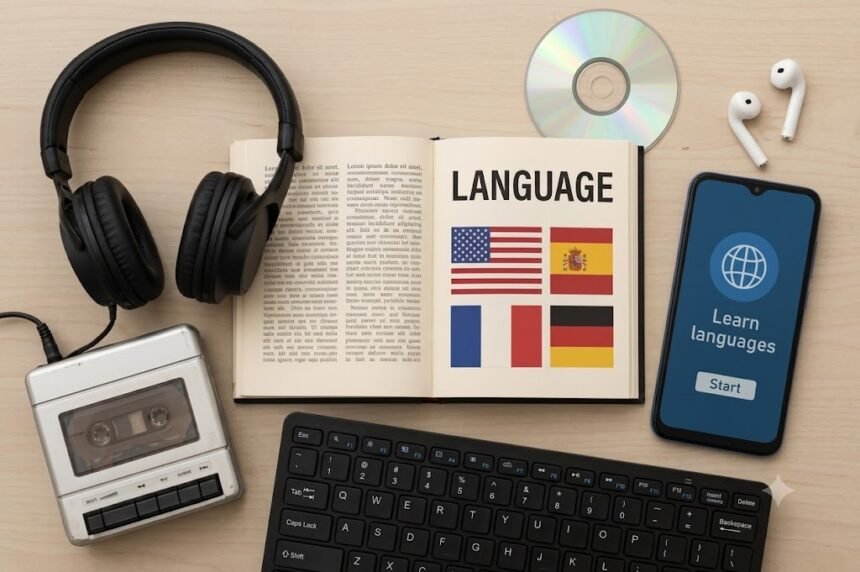
We’ve all been there: you download a flashy language app, commit to ten minutes a day, and feel great for exactly one week. Then, life happens. You miss a day, the guilt kicks in, and the app becomes just another icon on your home screen you ignore.

The problem isn’t your memory or your ability to learn; it’s the method. Most people approach language learning like they’re studying for a high school exam—focusing on grammar tables and vocab lists. But language isn’t a subject to be studied; it’s a tool to be used.
If you want to move from “total beginner” to “conversational” in record time, you have to stop memorizing and start living the language. Here is how to actually get there.
1. Follow the 80/20 Rule (Pareto Principle)
You don’t need to know every word in the dictionary to be fluent. In almost any language, the 1,000 most common words account for roughly 80% of daily conversation.
Stop wasting time on obscure vocabulary like “aardvark” or “typewriter.” Instead, download a Frequency List for your target language. Prioritize high-utility words: to be, to go, to want, I, you, it, food, time, help. Mastering these building blocks allows you to start forming real sentences within your first week.
2. Stop Treating Grammar Like Math
Grammar is the skeleton of a language, but vocabulary is the muscle. If you obsess over perfect verb conjugations before you can say a basic sentence, you’ll paralyze yourself with fear.
The Fix: Learn phrases, not rules. Instead of memorizing a conjugation chart for the verb “to eat,” learn “I want to eat.” You’ll pick up the grammatical structure naturally through repetition and context, which is how children learn—and how your brain is actually designed to retain information.
3. “Immersion” Doesn’t Require a Plane Ticket
You don’t need to move to Paris to be immersed in French. You just need to turn your immediate environment into a language lab.
- Change your phone’s system language: You already know where the buttons are by muscle memory; seeing them in your target language forces your brain to process new vocabulary automatically.
- The “Passive” Audio Trick: Play podcasts or radio in your target language while you commute, do dishes, or exercise. You won’t understand much at first, but you are training your ears to recognize the rhythm, cadence, and sounds of the language.
- Watch with subtitles (in the same language): Watching Netflix in Spanish with English subtitles is just watching a movie. Watching it with Spanish subtitles forces your brain to connect the spoken sound to the written word.
4. Prioritize Speaking (Even When You’re Bad at It)
This is the single biggest hurdle for most learners: the fear of sounding stupid. But here is the truth—you will sound silly, and that is exactly how you get better.
Find a language exchange partner on apps like HelloTalk or Tandem, or hire a tutor on iTalki for low-stakes conversation practice. The goal isn’t to be eloquent; the goal is to get comfortable being uncomfortable. The faster you make mistakes, the faster you correct them.

5. Use Spaced Repetition (SRS)
Cramming doesn’t work for long-term memory. Your brain needs to be reminded of information right before it’s about to forget it.
Use an app like Anki. It uses an algorithm to show you difficult words more frequently and easy words less frequently. Spending just 10–15 minutes a day on an SRS flashcard deck is scientifically proven to be more effective than two hours of sporadic, intense studying.
6. Build a “Micro-Habit” You Can’t Fail
The biggest killer of progress is the “all-or-nothing” mindset. If you aim for one hour a day, you will eventually quit.
Aim for 15 minutes. It’s long enough to learn something new, but short enough that you can’t use “I’m too busy” as an excuse. When you keep the barrier to entry low, you stay consistent. Consistency is the only “secret” to fluency.
The Bottom Line
Fluency isn’t a destination; it’s a byproduct of showing up. Stop stressing over perfect grammar, ditch the boring textbooks, and start using the language to talk about your actual life. If you focus on high-frequency words, get comfortable making mistakes, and keep your daily practice small and consistent, you’ll be surprised at how fast the language begins to stick.