



Virtual reality has had false dawns before. The technology would arrive with enormous promise, underwhelm on delivery, and retreat back into a niche that most consumers couldn’t quite justify. That cycle appears to have broken decisively in 2026. VR headsets are no longer just for gamers — they are gateways to immersive entertainment, remote collaboration, fitness, education, and even professional design. Standalone headsets now deliver experiences that rivalled high-end PC VR just two years ago, mixed reality passthrough has become standard across multiple price points, and the library of available content has grown to a scale where every type of user — gamer, fitness seeker, entertainment viewer — can find a compelling reason to own one. Here is how to choose the right one.
Understanding the Three Categories Before You Buy
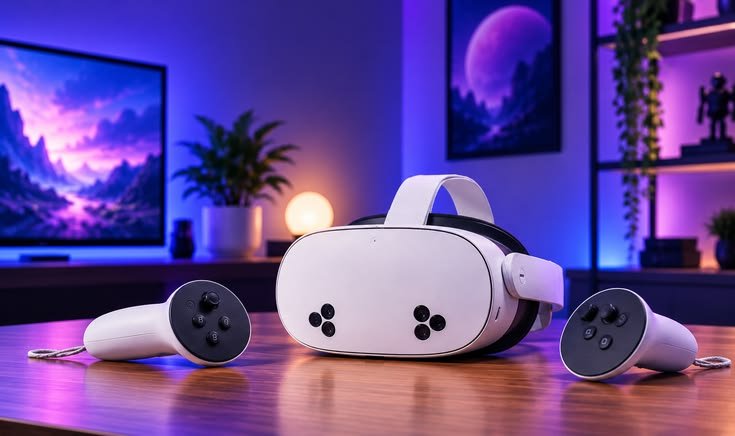
The first decision in any VR headset purchase is category, not brand. Standalone headsets run independently without a PC or console — the processing power is built into the headset itself, which means complete wireless freedom and a simpler setup experience. PC-tethered headsets connect to a gaming PC via cable or wireless link, delivering significantly higher visual fidelity at the cost of mobility and the additional expense of a capable gaming machine. Console-based headsets connect to a PlayStation 5, offering console-quality VR without the need for a gaming PC but limiting you to PlayStation’s exclusive library. Understanding which category fits your setup determines which specific models are worth considering.
Best Overall: Meta Quest 3
The best overall VR headset in 2026 is the Meta Quest 3. It balances solid performance, full-colour passthrough mixed reality, the largest content library, and pricing that delivers strong value for most users. The Quest 3 is a standalone headset — no PC or console required — running on the Snapdragon XR2 Gen 2 chip, with dual 2064×2208 per-eye resolution, a 90Hz refresh rate, and full-colour passthrough that delivers a clear, usable view of your real environment through the headset’s external cameras. Its full-colour passthrough is a game-changer for fitness, giving you a clear view of your room so you can move with confidence. The library is the strongest argument: over 500 titles, spanning gaming, fitness, social, and entertainment applications, with major new releases arriving regularly. The Meta Quest 3 at $499 is the right answer for the majority of buyers approaching VR for the first time or upgrading from earlier hardware.
Best Budget: Meta Quest 3S
Budget buyers get excellent value from the Quest 3S at $299. The Quest 3S uses the same Snapdragon XR2 Gen 2 chip as the Quest 3 and accesses the identical game and application library — the practical performance difference between the two is meaningful primarily to users who care about display sharpness at close range. For fitness applications, casual gaming, and entertainment streaming, the Quest 3S delivers an experience that most users find indistinguishable from the premium model in daily use. It is the most accessible entry point into a genuinely capable VR ecosystem currently available anywhere in the market.
Best for PlayStation Users: PSVR2
For households already invested in the PlayStation ecosystem, the PSVR2 delivers console-quality VR with exclusive titles that standalone headsets cannot access. The OLED panel, eye-tracking, and 120Hz refresh rate produce a visual quality that outperforms the Quest 3 on sharpness and colour accuracy — and PlayStation’s exclusive VR library includes titles of a quality that the standalone market has not yet replicated. The limitation is the tether: the PSVR2 connects to a PS5 via USB-C cable, which restricts the kind of full-body movement that fitness applications require. For seated or standing gaming experiences, it is exceptional. For fitness use cases requiring significant movement and room-scale freedom, the Quest 3 is the more practical choice.
Best Premium: Apple Vision Pro
Professionals and Apple users may find Apple Vision Pro’s premium worthwhile for spatial computing workflows. At $3,499, the Vision Pro is not a gaming headset or a fitness device — it is a spatial computing platform that happens to support entertainment and some gaming content. Its micro-OLED displays deliver the sharpest visuals of any headset currently available, and its visionOS operating system is the most sophisticated software platform in the XR category. For creative professionals, developers, or Apple ecosystem users who want spatial computing as a productivity tool with entertainment as a secondary use case, it justifies its price. For everyone else, it does not.
VR for Fitness: What Actually Works
Exergaming — exercising through video games — has been completely transformed by virtual reality. Instead of just watching a screen, you are placed directly inside the action, making your workout feel more like an exciting adventure than a chore. The Quest 3 and Quest 3S are the headsets that fitness-focused buyers should prioritise, for the simple reason that wireless freedom is non-negotiable for full-body movement. The fitness application library on Quest is the strongest available — Beat Saber for rhythm-based cardio, FitXR for structured group fitness classes, Thrill of the Fight for boxing training, and Supernatural (now transitioning platforms following its acquisition) for high-intensity full-body movement. Fitness-focused VR games help you stay active while having fun. Many users report improved coordination, reflexes, and focus after regular sessions.
The key fitness consideration beyond headset choice is space. A minimum of two metres by two metres of clear floor space is the practical requirement for any fitness application involving significant arm and body movement. Smaller spaces limit which applications function safely.
VR for Entertainment: What to Expect
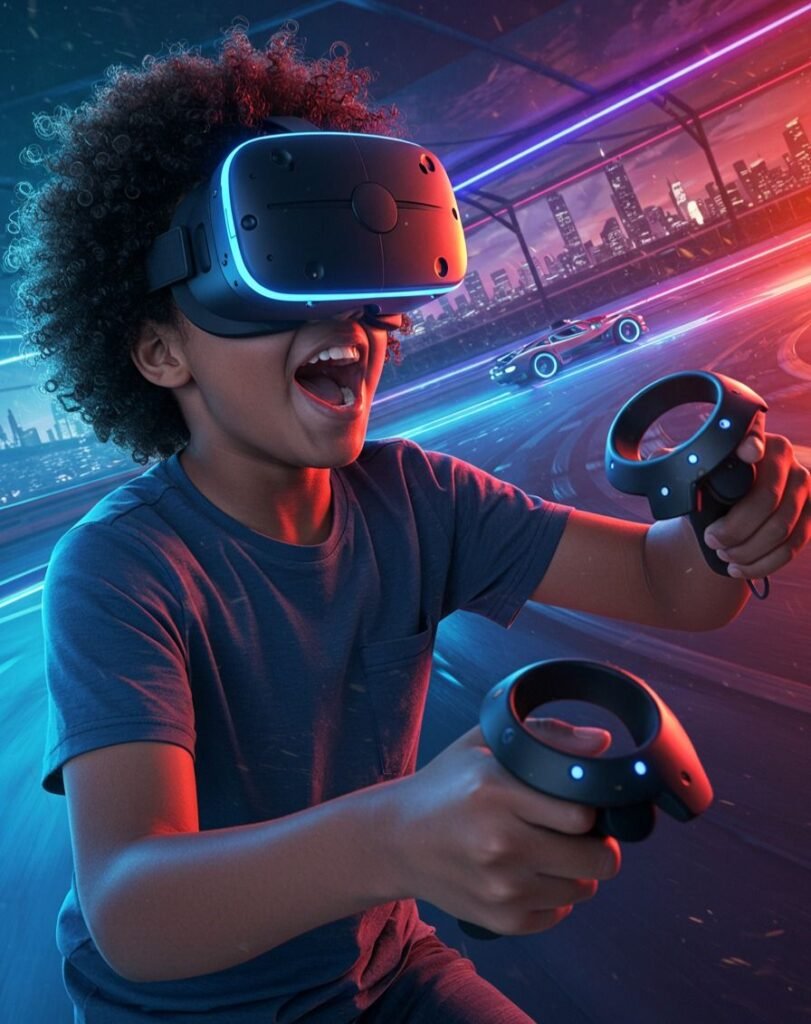
Entertainment on VR in 2026 extends beyond gaming into cinematic experiences, virtual concerts, social spaces, and travel simulations. The Quest 3’s mixed reality passthrough allows a user to watch a virtual screen overlaid on their real room — creating a personal cinema experience without a physical screen. Apple Vision Pro pushes this furthest, with its Immersive Video format delivering spatial video content from Apple TV+ in a format that produces a genuinely different viewing experience from conventional flat screens. For travellers, virtual destination experiences — walking through ancient Rome, standing at the edge of a Himalayan ridge — have matured into genuinely compelling content rather than tech demonstrations.
What to look for across every category is consistent: display resolution above 2000×2000 per eye for comfortable text and fine detail, a refresh rate of 90Hz or above to minimise motion discomfort, a comfortable weight distribution for extended sessions, and a content library that matches your specific use case. The headset that sits unused because the content library doesn’t match your interests is a poor investment regardless of its technical specifications. Match the device to what you will actually do with it, and VR in 2026 delivers an experience that justifies the purchase more convincingly than at any previous point in the technology’s history.